


In ten days, on August 12, 2026, the Moon’s shadow will cross the far north and then reach parts of Europe. Totality will be visible along a narrow path through Greenland, Iceland, and northern Spain, while a much wider region will see a partial solar eclipse. Later in the month, on August 27-28, a partial lunar eclipse will darken part of the Moon. The sequence is visually arresting, globally publicized, and almost certain to generate prophetic claims online.
Christians should look up. Scripture teaches that the heavens declare God’s glory, that the sun and moon serve His purposes, and that extraordinary heavenly signs will accompany decisive acts of divine judgment. Yet looking up is not the same as turning the sky into a private codebook. Watchfulness is not numerology, and readiness is not date-setting.
The present moment therefore requires two refusals. We must refuse the secular instinct that treats the heavens as spiritually mute matter. We must also refuse the sensational instinct that treats every eclipse as a timestamp for the Rapture, a secret message to one nation, or proof that a particular political event fulfills Revelation. The God who made the lights also gave us His written Word. Creation must be read under Scripture, not Scripture rearranged around an astronomical calendar.
This article argues that the August 2026 eclipses are real signs in the broad biblical sense that the ordered heavens witness to their Creator. They may rightly awaken wonder, humility, repentance, and eschatological sobriety. But the available evidence does not identify either eclipse as the specific fulfillment of Joel 2, Matthew 24, Acts 2, or Revelation 6. The Church should watch without panic, interpret without invention, and remain ready for Christ on every day, not merely on days when the sky darkens.
What Will Actually Happen in August 2026?
The basic facts are public and calculable. NASA’s eclipse catalog identifies a total solar eclipse on August 12, 2026 and a partial lunar eclipse on August 28. The solar eclipse belongs to Saros series 126 and follows a predictable path; the lunar eclipse belongs to Saros series 138. These are not dates discovered through a recent prophecy. Astronomers can calculate eclipses centuries in advance because God sustains an intelligible creation whose motions exhibit remarkable order (NASA Goddard Space Flight Center, 2026a; NASA Goddard Space Flight Center, 2026b).
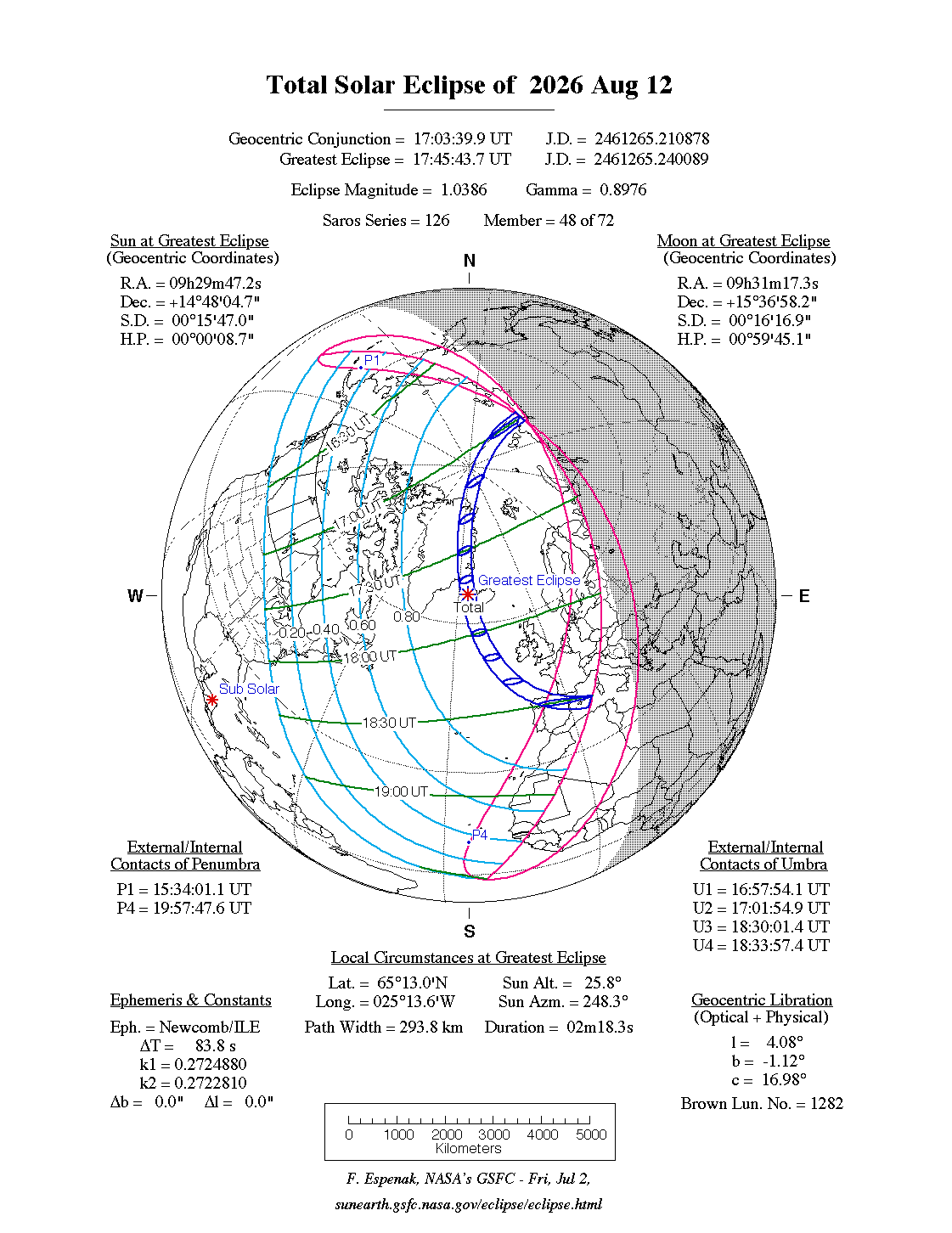
During a solar eclipse, the Moon passes between Earth and the Sun. Totality occurs only where the Moon’s umbral shadow reaches Earth’s surface. During a lunar eclipse, Earth passes between the Sun and Moon, and Earth’s shadow falls on the lunar surface. A total lunar eclipse can make the Moon appear coppery or red because sunlight passing through Earth’s atmosphere is filtered and bent toward the Moon. The August 27-28 event, however, is partial: only part of the Moon enters Earth’s darkest shadow.
That distinction matters because popular language often turns every lunar eclipse into a “blood moon.” The biblical phrase “moon to blood” is prophetic imagery embedded in scenes of the Day of the Lord. The modern media label is a visual nickname for atmospheric optics. The phrases may sound similar, but sound-alike language is not proof of prophetic identity.
The geographical path also requires restraint. Total solar eclipses always have paths. If totality crosses Spain, Iceland, or Greenland, that fact does not by itself pronounce a unique judgment on those places. A line drawn after the event can be made to intersect cities, historical anniversaries, borders, churches, battlefields, or symbolic shapes. The more data points one is willing to select, the easier it becomes to manufacture an apparently meaningful pattern. This is not biblical interpretation. It is retrospective pattern selection.
Christians may therefore receive the verified astronomical facts without surrendering a supernatural worldview. Predictability does not remove God. It displays His faithfulness. The same Lord who can interrupt created order also ordinarily upholds it “by the word of his power” (Hebrews 1:3).
Do the Heavens Give Signs?
Yes. The Bible says so plainly. God placed the lights in the expanse “to serve as signs and for festivals and for days and years” (Genesis 1:14-18). The heavens declare His glory, and their testimony reaches throughout the earth (Psalm 19:1-6). Jesus said there would be “signs in the sun, moon, and stars” and anguish among nations before the Son of Man comes with power and great glory (Luke 21:25-28).
But the word sign does not mean that every observer may assign any meaning to any celestial event. In Scripture, a sign is governed by God’s revelation. The rainbow signifies God’s covenant with Noah because God explicitly gave that meaning (Genesis 9:12-17). The star connected with Christ’s birth has meaning because Matthew’s inspired account identifies its role (Matthew 2:1-12). The darkness at the crucifixion belongs to the divinely interpreted history of the cross (Luke 23:44-49).
The controlling question is therefore not, “Can the heavens ever signify divine action?” They can. The question is, “Has God authorized the particular meaning being claimed?” Without scriptural warrant, an eclipse can become a blank screen upon which fear, political preference, private revelation, and internet speculation are projected.
Genesis 1 also contains a polemical warning. The Sun and Moon are not named as deities; they are created lights assigned functions by God. Israel was warned not to look to the heavenly host and be led into worshiping what God created (Deuteronomy 4:19). Isaiah mocked Babylon’s astrologers, who could not save the empire from judgment (Isaiah 47:12-15). Biblical watchfulness must never mutate into baptized astrology.
Reading Joel, Acts, Matthew, and Revelation in Context
Joel prophesied that the Sun would be turned to darkness and the Moon to blood “before the great and awe-inspiring day of the LORD comes” (Joel 2:28-32). Peter cited this passage at Pentecost after the Holy Spirit was poured out (Acts 2:16-21). Peter’s use shows that the last-days outpouring had begun, but it does not authorize Christians to declare every later eclipse a complete fulfillment of the entire oracle. Joel’s prophecy joins the Spirit’s outpouring, prophetic witness, wonders, judgment, and the saving promise that everyone who calls on the Lord’s name will be saved.
Jesus likewise placed the darkening of the Sun and Moon within an identifiable eschatological sequence: “Immediately after the tribulation of those days,” the celestial powers are shaken and the sign of the Son of Man appears (Matthew 24:29-31). Whatever one’s detailed chronology, the passage describes far more than an ordinary, geographically narrow eclipse. The nations mourn, the Son of Man appears in heaven, angels gather His elect, and the event is publicly bound to His royal arrival.
Revelation 6 is equally weighty. When the sixth seal is opened, there is a great earthquake, the Sun becomes black, the full Moon becomes like blood, stars fall, the sky is split, mountains and islands are moved, and rulers and peoples hide from the wrath of the Lamb (Revelation 6:12-17). To isolate the reddish Moon while ignoring the earthquake, falling stars, displaced terrain, opened sky, worldwide terror, and recognized wrath of the Lamb is not careful exegesis. It is selecting the one detail that resembles a familiar natural event and detaching it from the inspired scene.
These prophecies are true. Their fulfillment will not need an imaginative social-media thread to make them significant. The Day of the Lord will not be established by a collage of flight paths, feast dates, map overlays, and number patterns. God’s intervention will carry its own terrible clarity.
The Moon Is Rusting, but It Is Not Becoming a Blood Moon
The user’s earlier research list rightly noticed a striking scientific discovery: researchers detected widespread hematite, an oxidized iron mineral, at high lunar latitudes. Because the Moon has very little oxygen and liquid water, the finding was surprising. Li and colleagues used data from India’s Chandrayaan-1 mission and proposed that oxygen transported from Earth’s upper atmosphere through the magnetotail, together with trace water and impact processes, may help explain the oxidation (Li et al., 2020).
This is a fascinating finding. It is also easy to misstate. Hematite does not mean that the whole Moon has recently begun turning visibly red. The detected mineral is associated with portions of the lunar surface, especially at high latitudes. It is not the cause of the red appearance during a lunar eclipse. Eclipse redness arises chiefly because Earth’s atmosphere filters sunlight before it reaches the Moon.
Nor does the discovery prove that Joel’s “moon to blood” has begun through gradual mineral oxidation. Joel speaks of a public divine sign in the context of the Day of the Lord, not a remote-sensing mineral signature identified in scientific data. The hematite discovery can deepen wonder at the complexity of Earth-Moon interaction. It cannot bear a prophetic conclusion the text and evidence do not place upon it.
This is an important discipline for stigmatized knowledge claims. A verified anomaly may be genuinely surprising without validating every interpretation attached to it. Christians do not defend Scripture by exaggerating science. False precision weakens witness. The truth needs no decorated evidence.
Three Levels of Claim
The coming weeks will likely produce many assertions. They should be sorted carefully.
Verified fact: A total solar eclipse will occur on August 12, 2026. Its narrow path of totality crosses Greenland, Iceland, and Spain. A partial lunar eclipse will occur on August 27-28. These events are astronomically predictable (NASA Goddard Space Flight Center, 2026a; NASA Goddard Space Flight Center, 2026b).
Verified fact: Hematite has been detected on the Moon, and peer-reviewed research has proposed mechanisms involving oxygen from Earth’s upper atmosphere, water traces, and impact processes (Li et al., 2020).
Biblically responsible inference: Eclipses can remind believers that creation is ordered by God, human power is small, judgment is real, and Scripture’s promised cosmic disturbances are not beyond the Creator’s power. A darkened sky may awaken morally serious reflection even when it is not itself the specific fulfillment of an end-time prophecy.
Plausible coming trend: Social platforms and generative AI will make eclipse prophecy increasingly persuasive in appearance. Maps, timelines, numerical alignments, synthetic quotations, and dramatic videos can be produced in minutes. The result will be more content that looks researched while resting on selective coincidence. Churches will need stronger habits of source checking, contextual Bible reading, and patient correction.
Unsupported speculation: There is no adequate evidence that the August 12 eclipse identifies the day of the Rapture, pronounces a unique judgment on Spain or Europe, traces a secret occult boundary, activates a hidden technological ritual, or fulfills the sixth seal by itself. Claims of this kind require revelation or evidence that has not been supplied.
False teaching: Anyone who claims certainty about the day of Christ’s return from this eclipse contradicts Jesus’ warning that no one knows the day and hour (Matthew 24:36). A teacher who repeatedly announces dates, quietly deletes failed predictions, and moves to the next celestial event is not practicing watchfulness. He is training the flock to confuse excitement with faithfulness.
Watchfulness Without Date-Setting
Some Christians fear that caution will make the Church spiritually sleepy. The opposite is true. Date-setting creates short bursts of alarm followed by disappointment. Biblical watchfulness forms durable obedience.
Jesus’ parables of readiness do not command believers to solve an astronomical cipher. They command faithful service while the Master’s return remains certain and its timing unknown. The wise servant feeds the household and remains at his post (Matthew 24:45-51). The wise virgins keep oil in their lamps (Matthew 25:1-13). Peter asks what kind of people believers ought to be and answers: people marked by holy conduct and godliness (2 Peter 3:10-14).
The August sky should therefore move the Church toward worship, not superstition; repentance, not prediction; evangelism, not viral alarm; and hope, not fear. Families can observe the eclipse safely and teach children that the heavens belong to the Lord. Pastors can preach the biblical passages in context. Researchers can examine unusual claims without contempt but insist upon traceable evidence. Every believer can ask a more searching question than “What happens on August 12?”: If Christ came today, would He find me faithful?
There is also a pastoral duty to protect tender consciences. Some believers live under recurring fear that they will miss the Rapture because they misunderstood a sign, failed to decode a date, or did not follow a prophetic personality. The gospel does not rest on mastery of celestial patterns. Salvation rests on the crucified and risen Christ. “Everyone who calls on the name of the Lord will be saved” (Romans 10:9-13). Readiness is abiding in Him, walking in repentance, loving the truth, and persevering in faith.
The Sign to Which Every Sign Must Point
The heavens are not empty. They are not divine either. They are servants. The Sun rules the day only because God appointed it. The Moon marks seasons only because God sustains it. Eclipses can humble empires, stop crowds in silence, and remind an age of screens that there is still a creation human beings did not design.
But no eclipse can save. No blood-colored Moon can cleanse sin. No path of totality can reconcile a rebel to God. The decisive sign is the crucified and risen Son, before whom every other sign must bow. Jesus rebuked those who were skilled at reading the weather but unable to discern the time of His presence (Matthew 16:1-4). It is possible to become obsessed with the sky while missing the Lord of heaven.
So let the Church look up on August 12, where safe viewing is possible. Let us marvel at the precision of creation. Let us remember that the same Lord who orders the heavens has promised to shake what can be shaken. Let the coming eclipse rebuke our pride and renew our urgency. But let us not place words in God’s mouth.
The sky is a witness, not our private calendar. Christ is coming. The exact day does not belong to us. Faithfulness today does.