


The Tower of Babel was never merely an ancient construction project. It was a spiritual declaration. After the flood, God commanded humanity to spread across the earth, multiply, and fill it under His authority. Yet in Genesis 11:1–9, mankind gathers in Shinar, builds a city and a tower, and says, “Let’s make a name for ourselves.” That sentence is the heart of Babel. It is humanity attempting unity without God, greatness without obedience, security without trust, and heavenward ambition without repentance.
This matters deeply today because Babel is not only a past event. Scripture presents Babylon as a recurring spiritual pattern that finally reappears in the last days. The Bible begins with Babel’s city-building rebellion in Genesis and ends with Babylon’s global system in Revelation. Revelation 13:16–17 describes a future order in which buying and selling become tied to allegiance. Revelation 17–18 portrays Babylon as a religious, political, commercial, and cultural power intoxicated with wealth, influence, deception, and spiritual adultery. The final tower, therefore, may not be a single brick structure. It may be a whole civilization built from architecture, law, digital identity, financial systems, artificial intelligence, quantum computing, transhumanism, and religious compromise.
A sober Christian must avoid two opposite errors. The first is naivety, pretending that symbols, institutions, technologies, and global systems are always neutral. The second is reckless speculation, claiming more than the evidence can bear. Biblical discernment does not require us to invent hidden meanings everywhere. It requires us to ask what spirit is being expressed, what vision of humanity is being promoted, and whether man is being trained to trust God or to trust a centralized system that promises safety, unity, intelligence, immortality, and transcendence apart from Christ.
The European Parliament building in Strasbourg is one of the most discussed modern examples. Its Louise Weiss building is an official seat of the European Parliament, inaugurated in 1999 and named after Louise Weiss, a French European parliamentarian and women’s rights advocate (Europeana, n.d.). The building was designed by Architecture-Studio, and architectural descriptions note its large scale, distinctive 60-meter tower, and inspiration from Roman amphitheatres rather than an officially declared imitation of Bruegel’s Tower of Babel painting (Archello, n.d.). The city of Strasbourg’s own description says the tower has “a look of the unfinished about it” and that this unfinished appearance illustrates “the ongoing nature of the European project” (Strasbourg.eu, n.d.).
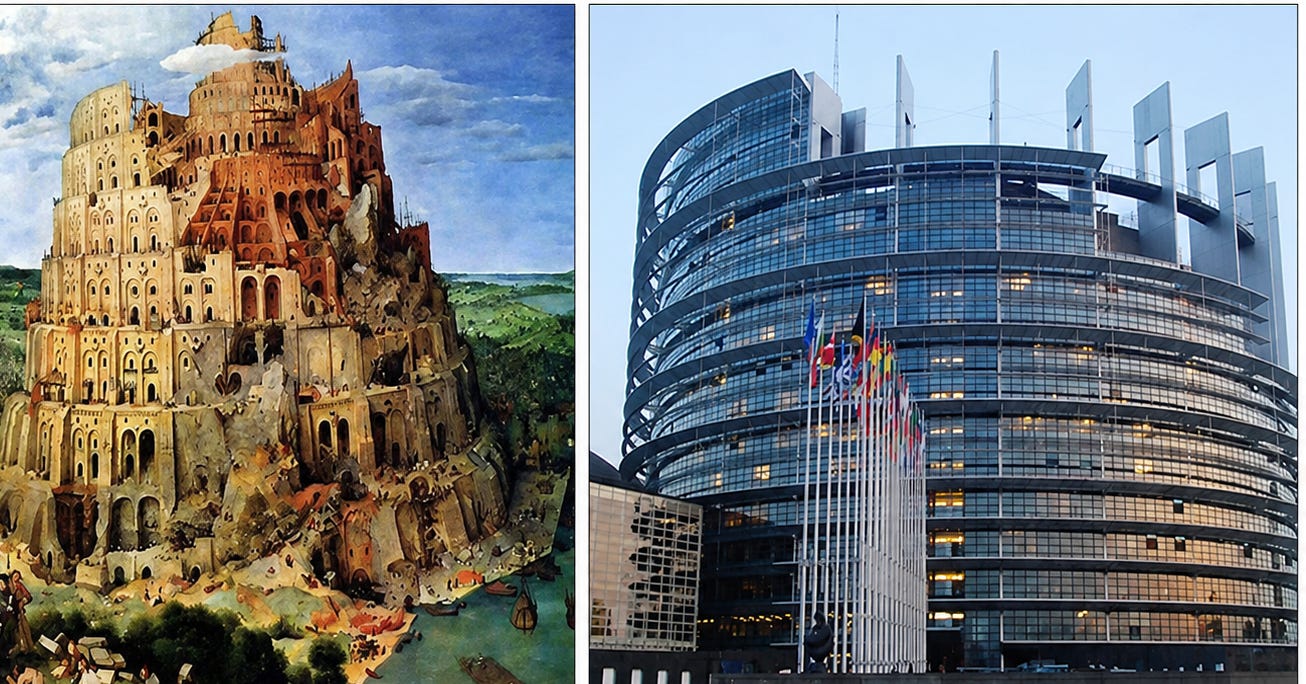
That careful distinction matters. The strongest argument is not that every architect consciously intended to rebuild Babel. The stronger and more defensible argument is that the building’s form, function, and public associations echo Babel’s grammar. Babel gathered humanity into one centralized project. The European Parliament gathers many nations, languages, and legal systems into one supranational legislative chamber. Tourism material for Alsace even describes the Parliament’s multilingual hemicycle as “like a Tower of Babel” where translations in 24 languages allow visitors to hear “Europe’s heart” (Visit Alsace, n.d.). Christian commentators have therefore connected the Parliament’s unfinished-tower symbolism to Babel, though such claims should be weighed against official architectural sources rather than repeated carelessly (Time of Reckoning Ministry, 2019). Discernment requires both boldness and accuracy.
The visual comparison often refers to Pieter Bruegel the Elder’s famous painting, The Tower of Babel, completed in 1563 and held by the Kunsthistorisches Museum in Vienna. The museum describes Bruegel’s work as the most famous and widely copied classic of Tower of Babel depictions (Kunsthistorisches Museum, n.d.). This matters because modern architectural forms do not communicate in a vacuum. They draw on inherited visual memory. When a public building resembles a widely recognized image of Babel, while also representing political unity across many tongues, the Christian observer is not foolish to ask what cultural imagination is being activated. The issue is not paranoia. The issue is interpretation.
The United Nations Headquarters in New York offers another Babel pattern, though in a different way. It is not shaped like Bruegel’s tower, and we should not pretend that it is. Its symbolism is institutional rather than architectural. The United Nations presents its headquarters through the language of a “Workshop for Peace,” highlighting an international design process after World War II (United Nations, 2025). The UN Charter’s preamble declares the ambition to save future generations from war, reaffirm human dignity, promote social progress, and combine the efforts of nations to accomplish these aims (United Nations, 1945). Christians can appreciate the desire to restrain war and protect human life. Yet Scripture also warns that fallen humanity’s deepest crisis cannot be solved by institutions alone. Psalm 2:1–4 shows nations raging and rulers plotting together against the Lord and His Anointed. The issue is not cooperation itself. The issue is cooperation that enthrones human consensus above divine authority.
This is why Babel is relevant to futuristic megaprojects. Consider Saudi Arabia’s planned Mukaab in Riyadh. Official descriptions present it as New Murabba’s “icon of innovation,” designed to redefine Riyadh’s skyline through immersive entertainment, cultural attractions, and advanced urban experiences (New Murabba, n.d.). Saudi reporting has described The Mukaab as the centerpiece of New Murabba and connected it with visionary immersive experiences (Saudi Press Agency, 2025). Again, the problem is not that a large building is automatically sinful. The deeper question is theological: what does it mean when civilization increasingly builds enclosed worlds of spectacle, simulated reality, luxury, commerce, and technological enchantment? What happens when the city becomes not merely a place to live, but a designed environment that shapes perception, desire, identity, and worship?
NEOM’s The Line raises similar concerns. The official announcement described it as a 170-kilometer city planned around zero cars, zero streets, and zero carbon emissions, with essential daily services intended to be within a five-minute walk (NEOM, 2021). Many will praise such projects as sustainable urban innovation. Some of that praise may be sincere. Yet the biblical mind asks a deeper question: when “smart cities” become total environments, who controls the data, the access, the mobility, the permissions, and the definitions of acceptable life? Babel was a city before it was a tower. Its sin was centralized autonomy, a managed human order resisting God’s command. The danger today is not only height, glass, or concrete. It is the construction of systems where human life becomes legible, programmable, and governable by powers that do not bow before Christ.
Artificial intelligence belongs to this same architecture. AI is not a tower of stone, but it may become a tower of cognition: a vast computational structure through which human decisions, images, speech, finance, education, warfare, medicine, and governance are increasingly mediated. UNESCO’s Recommendation on the Ethics of Artificial Intelligence identifies human dignity, human rights, transparency, fairness, and human oversight as essential concerns in AI development (UNESCO, 2021). NIST’s Artificial Intelligence Risk Management Framework likewise treats AI as a socio-technical system that must be governed for risks related to validity, reliability, safety, security, accountability, transparency, privacy, and fairness (NIST, 2023). The European Union’s AI Act creates a harmonized legal framework for AI systems in the EU and explicitly frames its purpose around human-centric and trustworthy AI while addressing risks to safety and fundamental rights (European Parliament & Council of the European Union, 2024).
Those sources are not Christian prophecy teachers. They are secular and official. Their concern itself proves the point: AI is not merely a convenient tool like a calculator. It is becoming a layer of civilization. When AI systems classify, recommend, generate, predict, surveil, censor, authenticate, and automate, they do not simply help people do tasks. They begin to shape what people see, what they believe is credible, what they are allowed to access, and how institutions make decisions about them. The Christian question is not whether AI can be useful. It can. The question is whether humanity is building an intelligence infrastructure that will quietly replace wisdom, conscience, pastoral discernment, and dependence on God. Proverbs 3:5–6 tells us to trust in the Lord with all our heart and not rely on our own understanding. What happens when a civilization stops relying even on human understanding and begins outsourcing moral judgment to machines trained by fallen human data?
The danger becomes sharper when AI is joined to transhumanism. Transhumanism is not simply the use of medicine to heal disease. Christianity has never opposed healing, surgery, prosthetics, or responsible scientific research. The deeper issue is the desire to redesign humanity beyond God-given creaturely limits. The Transhumanist Declaration, adopted by Humanity+ in 2009, states that humanity will be profoundly affected by science and technology and envisions the possibility of overcoming aging, cognitive shortcomings, involuntary suffering, and even confinement to planet Earth (Humanity+, 2009). That language sounds compassionate at first. Who does not want relief from suffering? But beneath it lies a foundational question: is man a creature to be redeemed by God, or a platform to be upgraded by technology?
Scripture answers clearly. Humanity is not an unfinished machine. We are made in the image of God (Genesis 1:26–27), fallen through sin (Romans 5:12), and offered redemption through Jesus Christ (Romans 3:23–24). The biblical problem is not that humans lack enough intelligence, biological enhancement, or computational power. The problem is sin. A spiritually dead person does not need merely a better brain. He needs new birth (John 3:3). A corrupt world does not need only better systems. It needs the righteous reign of Christ. A dying body does not need technological immortality as its final hope. It needs resurrection (1 Corinthians 15:42–49).
Brain-computer interfaces make this discussion more concrete. A 2024 peer-reviewed review in Surgical Neurology International notes that brain-computer interfaces are becoming a tangible reality and discusses the significance of FDA approval for Neuralink human trials, while also recognizing the therapeutic potential for patients with serious neurological conditions (Sarkar et al., 2024). We should be fair. Technologies that help paralyzed patients communicate or regain function can be acts of mercy when governed responsibly. Yet the same pathway can also shift from healing the broken body to enhancing the “obsolete” human. Once the human brain becomes an interface, who guards the boundary between therapy and control, between assistance and manipulation, between medical restoration and spiritual counterfeit?
This is where Babel becomes more than a building. Babel was the ancient attempt to overcome dispersion, weakness, mortality, and dependence through centralized human achievement. Transhumanism attempts something similar at the level of the body and mind. AI attempts it at the level of intelligence and decision-making. Quantum computing attempts it at the level of computational power. Smart cities attempt it at the level of environment and governance. Digital identity attempts it at the level of access and authentication. Programmable finance attempts it at the level of buying and selling. Put together, these are not isolated innovations. They are components of a possible final system.
Quantum computing may seem unrelated to buildings at first, but it belongs to the invisible architecture of the final tower. IBM describes quantum-centric supercomputing as a future computing architecture that combines scalable quantum execution with advanced classical computation (IBM, 2023). Google’s Quantum AI team presents its Willow chip as a step toward useful, large-scale quantum computers, emphasizing progress in error correction and performance (Google, 2024). NIST’s post-quantum cryptography program shows that governments already recognize quantum computing as consequential enough to require new security standards for future digital communication (NIST, 2024). None of this means quantum science is evil. Christians should not fear honest investigation of God’s creation. But we must discern the spiritual temptation attached to technological power: the dream of mastering reality so thoroughly that mankind no longer feels accountable to the Creator.
In Genesis, Babel required one language. Today, the world is constructing digital equivalents of one language: interoperable identity, programmable money, global standards, machine-readable behavior, automated governance, and AI-readable human life. The European Digital Identity Regulation establishes a framework for a European Digital Identity Wallet, aiming to support trusted electronic identification across the European Union (European Parliament & Council of the European Union, 2024). The European Commission describes this wallet as a universal, trustworthy, and secure digital identity instrument for citizens, residents, and businesses (European Commission, n.d.). The Bank for International Settlements has explored tokenization and future monetary systems built around central bank money as a foundation of trust in digital finance (BIS, 2023). These developments are often presented as convenience, security, and efficiency. They may indeed offer practical benefits. But Revelation 13:16–17 warns that the final beast system will involve economic exclusion tied to allegiance. Therefore, the wise Christian does not shout that every digital wallet, AI system, or biometric tool is the mark of the beast. He asks whether the infrastructure of a future buy-and-sell control system is being normalized before our eyes.
The Bible’s answer to Babel is not isolation, fear, or anti-intellectualism. God is not threatened by human architecture, scientific discovery, responsible medicine, or international cooperation. Psalm 127:1 simply tells the truth: unless the Lord builds the house, its builders labor over it in vain. The question is not whether mankind can build astonishing things. The question is whether those things are built in submission to God or in defiance of Him.
Pentecost is the holy reversal of Babel. At Babel, languages were confused because human unity had become rebellion. At Pentecost, in Acts 2:1–11, many languages heard the mighty works of God through the power of the Holy Spirit. Babel says, “Let’s make a name for ourselves.” Pentecost proclaims the name of Jesus Christ. Babel centralizes power. Pentecost sends witnesses to the nations. Babel builds upward in pride. The gospel bows low at the cross and receives grace from above.
So yes, the final tower is being built, but not always in the way people imagine. It is being built wherever humanity seeks unity without repentance, peace without the Prince of Peace, intelligence without wisdom, enhancement without holiness, commerce without conscience, identity without the image of God, and worship without Christ. Some buildings make the pattern visible. Some technologies make it functional. Some institutions make it legal. Some narratives make it desirable. The Christian task is not panic, but vigilance.
We must ask ourselves: are we being discipled by Scripture or by the architecture of the age? Do we admire power more than holiness? Do we confuse technological wonder with divine wisdom? Are we slowly accepting a world where access to life depends on compliance with systems that may one day demand worship? Are we teaching our children that the highest hope is to be upgraded, optimized, and connected, or to be forgiven, sanctified, and conformed to the image of Christ?
Our hope is not in escaping complexity by human strength. Our hope is Jesus Christ, who is building not Babel, but His Church. Matthew 16:18 assures us that the gates of Hades will not overpower it. The towers of men rise and fall. Babylon dazzles and collapses. AI may become powerful. Transhumanist dreams may become more persuasive. Smart cities may become more immersive. Digital identity may become more normalized. But the kingdom of Christ cannot be shaken. Therefore, we watch, we test, we refuse deception, and we remain ready. The final tower may be rising, but the King is coming.
Recommended Readings
What is the Difference between Being Religious and Being a Christian?
When the Earth Breaks and the Watchmen Sleep: A Prophetic Cry to the Wise Virgins
What are/How do the Illuminati’s 14 Stages of World War III Align with Biblical Prophecy?
When Babel Becomes Beautiful: The Parable of Cultural Blend and the Death of Distinction
The Silence of the Saints: Why the Church No Longer Speaks Against the Powers of the Age
What are the Potential Connections Between Modern Technology Brands and Occult Symbolism?
Birth Pangs and Beast Crowns: Operation Rising Lion and the Luciferian Midwife of World War III?
Further Resources
Explore Online Ministry Opportunities at Open Christian Ministries (USA)
Explore Christian Business Services at the Center for Faith and Work (Rwanda)
Pursue an Affordable Online Christian Degree at Open Christian University (USA)
Stay updated and connect with our community by subscribing to our email list Here
Kindly Share Your Question for Consideration in Future Articles. Click Here to Submit
Ask a Question or Utilize Our Trained AI Bot to Craft Your Evangelical Article - Begin Here
Access Educational Videos in Kinyarwanda at Center for Faith and Work or in English at Open Christian Ministries.